Login

We are experiencing technical difficulties. Your form submission has not been successful. Please accept our apologies and try again later. Details: [details]

Register

We are experiencing technical difficulties. Your form submission has not been successful. Please accept our apologies and try again later. Details: [details]

Thank you for registering

An email to complete your account has been sent to

Return to the website

get direct access

Fill in your details below and get direct access to content on this page

Text error notification

Text error notification

Checkbox error notification

Checkbox error notification

We are experiencing technical difficulties. Your form submission has not been successful. Please accept our apologies and try again later. Details: [details]

Thank you for your interest

You now have access to A 10A power supply is not always a 10A power supply in the real world.

A confirmation email has been sent to

Continue to page

Please or get direct access to download this document

Industry 4.0

A 10A power supply is not always a 10A power supply in the real world.

Published on 11 June, 2026 in Industry 4.0

That number on the label is a rating, not a promise. It's the current the unit can deliver under a defined set of conditions, and the conditions inside a real control cabinet are rarely the ones on the datasheet's front page.

Most sizing exercises start the right way: add up the loads. Controller, I/O, sensors, an HMI, a handful of relays. Sum the steady-state draw, add a margin, pick the next size up. Sensible, but it only accounts for the load on a good day, sitting still.

Real machines don't sit still. Contactors and solenoids pull far more on pickup than they hold at. Capacitive loads: HMIs, industrial PCs, DC/DC converters, electronic protection modules, and anything with a bank of capacitors on its input can look momentarily like a short circuit at power-up. Add enough of them and your "well within budget" supply can be driven into current limit or hiccup mode at the worst possible moment: switch-on. The peak demand, not the average, is what decides whether the machine starts reliably.
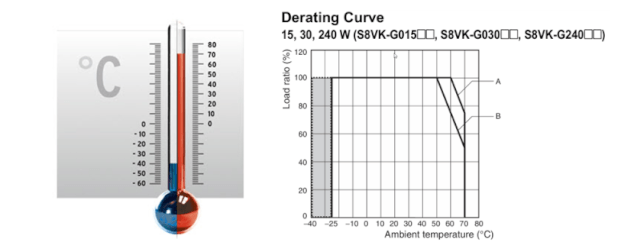
Then there's the cabinet itself. A supply rated for full output at 25°C will not give you full output at 55°C, and a sealed panel in a warm plant gets there easily. Every quality DIN-rail PSU carries a derating curve for exactly this reason: above a certain ambient, available current falls away. The honest question isn't "does it meet the load on the bench?" but "does it still meet the load at the worst temperature it'll ever see, with the cabinet door shut?"

And it isn't only temperature that erodes the headline figure. The 24 V on the label is the voltage at the supply's terminals, not the voltage at the load. Push current down a long or thin cable run and the volt drop means a sensor or valve at the far end can sit below its minimum operating voltage, even while the PSU itself is behaving perfectly. The device drops out, the fault looks intermittent, and the supply gets the blame for something the wiring did. The fixed output isn't even fixed: most quality supplies let you trim the voltage up a little to claw the drop back. Useful, but it's compensation rather than a free lunch, since everything nearer the cabinet now runs at that higher voltage too.
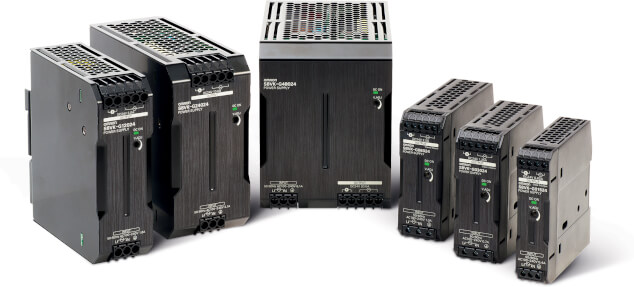
This is where headroom earns its place. OMRON's S8VK-G range is built around it: a power-boost capability that handles the startup and inrush spikes without forcing you to oversize the whole unit, an adjustable output to compensate for line losses, and published derating curves so you can size against your actual ambient rather than a lab one. It turns variables you'd otherwise meet on commissioning, namely peak demand, thermal derating, voltage drop and a sensible margin, into things you can specify on purpose.

Adding up the loads tells you where to start. It rarely tells you where to stop.
Contact us for more information

Contact Omron specialists

Do you have any questions or would you like personal advice? Feel free to contact one of our specialists.
  • Omron Europe

    Omron Europe