You Know OMRON. You've Just Never Met This Part of It.
Published on 08 July, 2026 in Industry 4.0
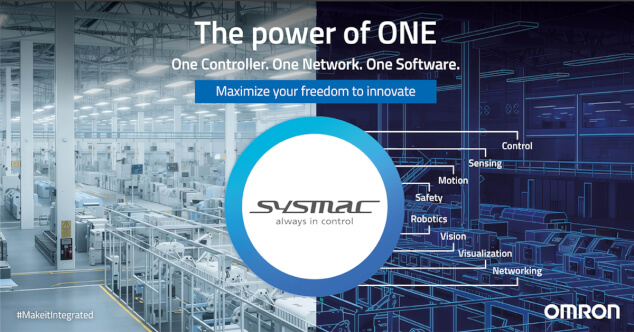
Most machine builders settled the controller question years ago. You standardised on a major platform, learned it inside out, and stopped looking, which was a perfectly reasonable thing to do. The incumbents are genuinely capable, your team is fluent, and changing a standard isn't a trivial cost. This isn't an argument for tearing that up.
It's the thing that's easy to miss: you almost certainly already know OMRON. There may be its safety relays in your panel, its sensors on your conveyor, its vision system on the inspection station. What far fewer people realise is that the same company has been building programmable controllers since 1971, and that the controller, not just the components around it, is a complete machine-control platform. You know the brand. You've just never been properly introduced to this part of it.
So start with the obvious question: can it do what your current platform does? Yes. IEC 61131-3, structured text, a full engineering environment, version control, offline simulation, build-time error checking. The things you'd check on day one is all there, and broadly on par with what you use now. I won't claim it's better at the things you already do well. It's level, and that's the point: parity means a serious look costs you nothing in capability. (How that environment actually feels to work in is a longer conversation, and one for the next piece.)
If it's level on the programming, why look at all? Because the more useful question isn't how you program the machine. It's what you're free to connect it to.
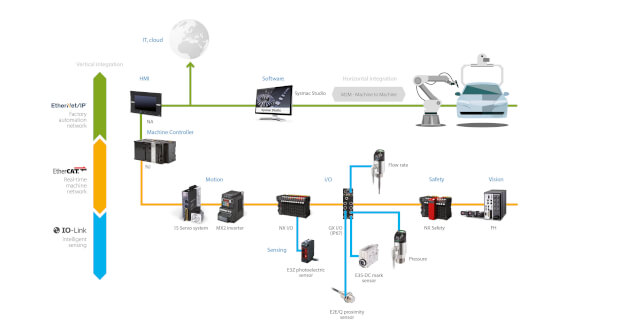
SYSMAC is built on open, multi-vendor networks rather than one of OMRON's own. EtherCAT runs the machine itself: deterministic and fast, the right tool for coordinated motion. EtherNet/IP carries it up to the plant, so the machine drops into a line already speaking that language. And IO-Link reaches down to the sensor and actuator layer, the part OMRON arguably knows better than anyone, pulling diagnostics and device parameters back up through the same open architecture.
Three open standards across three levels: device, machine, plant. That's the quiet difference. Most platforms are built around a network of their own and naturally steer you onto it; OMRON doesn't have one to sell you, so it builds on the standards the whole industry already shares. The architecture decisions stay yours.
You weren't wrong to standardise on what you've got. It's only worth knowing that the company you already trust for the sensing and the safety has, all along, been building the thing that runs the machine, and that it's earned a place in the conversation the next time the question's genuinely open.