We are experiencing technical difficulties. Your form submission has not been successful. Please accept our apologies and try again later. Details: [details]
Register
We are experiencing technical difficulties. Your form submission has not been successful. Please accept our apologies and try again later. Details: [details]
Thank you for registering
An email to complete your account has been sent to
Fill in your details below and get direct access to content on this page
We are experiencing technical difficulties. Your form submission has not been successful. Please accept our apologies and try again later. Details: [details]
Thank you for your interest
You now have access to
SYSMAC - A Name Older Than Most of the Engineers Using It
We are experiencing technical difficulties. Your form submission has not been successful. Please accept our apologies and try again later. Details: [details]
SYSMAC - A Name Older Than Most of the Engineers Using It
Published on 08 June, 2026 in Brand Protection
Many brands in industrial automation don't last. Product lines get absorbed, renamed, or quietly retired whenever a company is acquired or a strategy shifts. SYSMAC has done the opposite. The name has sat on OMRON's programmable controllers since the early 1970s, and it's still on the controller you'd specify today. That's not marketing longevity for its own sake; it's roughly 55 years of unbroken lineage on the same class of product.
It helps to remember why it existed at all. In 1967, OMRON (then Tateisi Electric, the firm whose Kyoto home district, Omuro, would later give the company its name) set up a study group to do something unusual for a components manufacturer: predict the future. The result was SINIC theory, a model presented internationally in 1970 that mapped how society, science, and technology pull one another forward. The conclusion that matters to us: manufacturing was heading toward smaller batches, more variety, and faster change. The rigid relay panels of the day simply couldn't keep up. OMRON's answer in 1971 was a programmable controller it called SYSMAC.
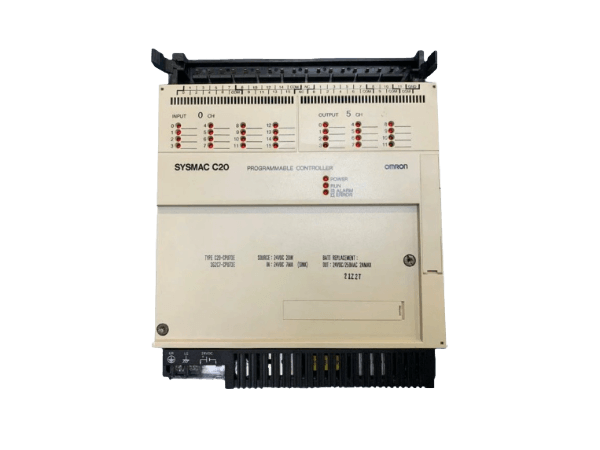
OMRON expands the name as System for Machine Automation Control, and that phrase has aged remarkably well, because it describes an ambition rather than a piece of hardware. The first SYSMAC units replaced cabinets of hand-wired relays with something an engineer could reprogram. The C-series that followed became one of the foundations of Japanese factory automation. Through the 1980s OMRON pushed into fuzzy logic; across the CV, CS, and CJ generations the controllers grew faster, smaller, and far more connected. The name stayed put.
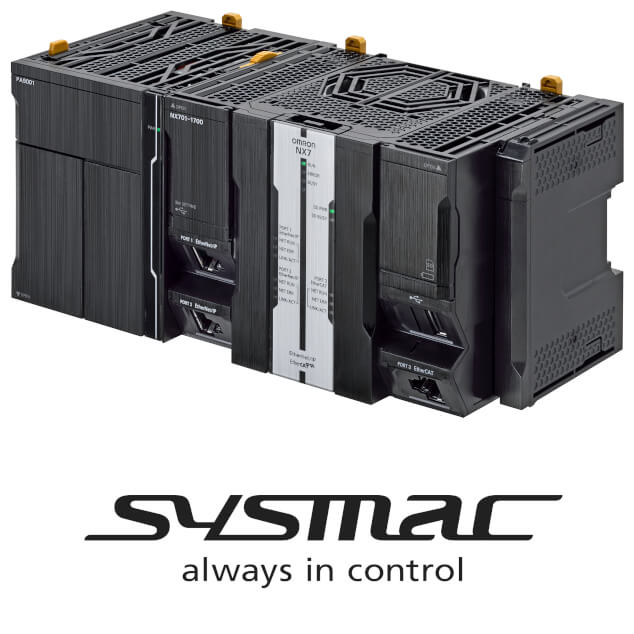
That continuity is the whole point. When OMRON relaunched SYSMAC in 2011, this time as a complete platform built around the NJ controller, Sysmac Studio software, and the EtherCAT network, it wasn't bolting a heritage badge onto something new. It was doing in 2011 what it set out to do in 1971: collapse the messy, fragmented parts of machine control into one coherent system. Motion, logic, safety, vision, networking: one controller, one software, one connection. The scope had grown from "replace the relay panel" to "run the entire machine," but the through-line never broke.
There's a credibility dividend in that. In industrial control, the platforms that endure are the ones that keep absorbing whatever the industry throws at them rather than being torn out and replaced. SYSMAC has done exactly that: fuzzy logic, industrial Ethernet, integrated motion, robotics, and now digital-twin simulation, all folded in under the same name. The badge stayed the same because the platform beneath it kept earning it.
It's worth knowing that foundation. SYSMAC isn't a product that merely happens to be old. It's a 55-year-old idea about what machine control should be, and most of that idea has quietly come true.