Smart Manufacturing Starts at the Sensor
Published on 11 June, 2026 in Flexible Manufacturing
How IO-Link turns simple devices into useful sources of machine data
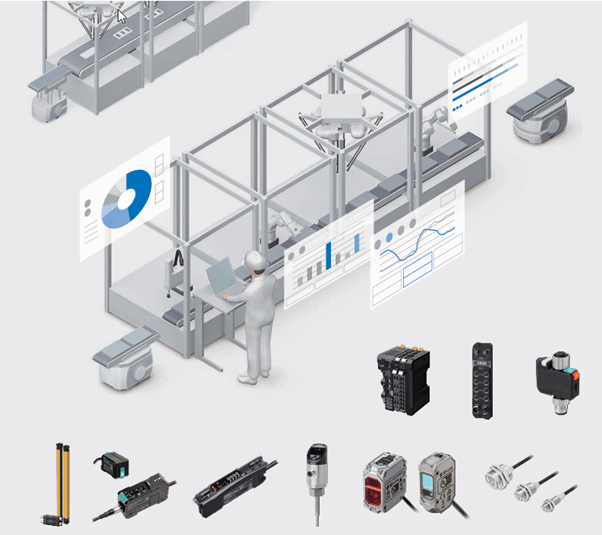
Walk onto most factory floors and you'll find sensors doing a remarkably limited job. A part is present, or it isn't. On, or off. For decades that single switched signal was all a machine needed, and for plenty of tasks it still is. The trouble is that "on or off" tells you what happened, but almost nothing about why it happened, or in the case of reducing unplanned downtime, whether it is about to stop happening.
IO-Link closes that gap. It's a point-to-point communication standard, the first sensor-level I/O technology adopted internationally (as IEC 61131-9), and it sits underneath your industrial fieldbus rather than replacing it. Each device connects to a port on an IO-Link master; the master collects the data and passes it up to the controller over whatever network you already run, be that EtherCAT, EtherNet/IP or similar. Crucially, this happens over the standard three-wire industrial cable a conventional sensor already uses, up to around 20 metres. No screened cabling, no special connectors.
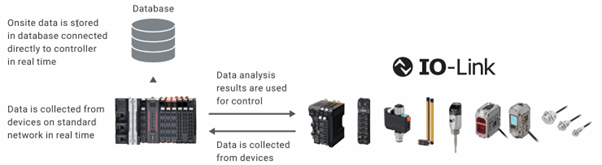
What travels down that cable is the interesting part. Alongside the familiar process value, an IO-Link device can report diagnostics, internal status and its full parameter set, and communication runs both ways, so it can be configured remotely too. A photoelectric sensor can flag that its received light level is drifting before it drops out entirely. A device can be swapped on the line and have its parameters written back automatically from the controller, rather than an engineer crouched on the floor re-teaching settings by hand.
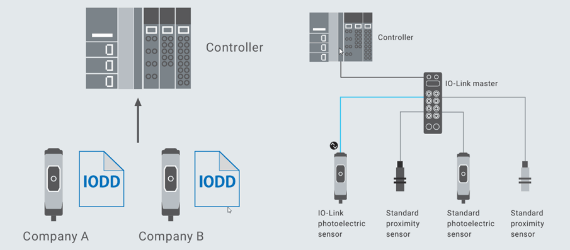
That portability comes from the IODD (IO Device Description) file associated with every IO-Link device. Because the format is standardised across over 500 manufacturers, an engineering tool reads a sensor's parameters and capabilities the same way regardless of who made it, so you're not locked to a single vendor's ecosystem just to get the data out.
A word on speed, because it's a fair question. IO-Link is not fast. The three communication rates top out at 230.4 kbps (COM3), with COM1 and COM2 below that. That's by design rather than limitation: it's built for sensor-level housekeeping such as status, diagnostics, measured values and configuration, not high-speed applications such as motion control, and it isn't pretending to be.
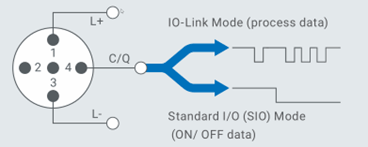
The feature that makes adoption painless is dual-mode operation. An IO-Link port can run in IO-Link mode for digital communication or fall back to standard I/O (SIO) mode, plain switched input/output, for a conventional sensor. You can mix compliant and non-compliant devices on the same master, which means there's no need to convert a whole machine at once. The sensible starting point is usually the single device causing grief: the one behind your most frequent stoppages, or the one whose data you actually want.
That same dual-mode behaviour is why IO-Link now appears as standard across many newer sensor ranges. A few specialised ranges still sit outside that pattern, but for many everyday workhorse devices it has become the default.
When connected to an IO-Link master, the device provides process data, diagnostics and parameters. Connected to a normal digital input, the same sensor behaves like a conventional switched output. For spares, that matters. One part number can cover both the IO-Link installation and the conventional one, instead of stocking two versions of what is physically the same device.
It's also worth knowing that IO-Link reaches well beyond sensors. The same standard runs on pneumatic valve manifolds, light curtains, power supplies, signal towers, RFID heads and more, so the data and diagnostics story aren’t confined to one corner of the machine. Once there's a master in the cabinet, it can become the common thread through a surprising amount of what's bolted onto the equipment.
That incremental path is where the real value sits. The headline benefits, faster fault recovery, genuine predictive maintenance, and quicker changeovers when a format or recipe switches, don't require ripping out the existing machine architecture. They come from making the bottom layer of it articulate.
And that's the shift worth holding onto. "Smart manufacturing" tends to be sold from the top down: cloud platforms, dashboards, digital twins. All of it depends on data, and if the information leaving the floor is still just on or off, there's a hard ceiling on how clever the layers above can be.
Smart manufacturing doesn't always start with a cloud platform. Sometimes it starts with a better conversation with the sensor.