Login

We are experiencing technical difficulties. Your form submission has not been successful. Please accept our apologies and try again later. Details: [details]

Download

Register

We are experiencing technical difficulties. Your form submission has not been successful. Please accept our apologies and try again later. Details: [details]

Download

Thank you for registering

An email to complete your account has been sent to

Return to the website

get direct access

Fill in your details below and get direct access to content on this page

Text error notification

Text error notification

Checkbox error notification

Checkbox error notification

We are experiencing technical difficulties. Your form submission has not been successful. Please accept our apologies and try again later. Details: [details]

Download

Thank you for your interest

You now have access to Simulation: from concept to virtual twin

A confirmation email has been sent to

Continue to page

Please or get direct access to download this document

Industry 4.0
Operational Excellence
smart manufacturing

Simulation: from concept to virtual twin

Published on 04 June, 2025 in Industry 4.0

Simulation: from concept to virtual twin

How can manufacturers harness the power of simulation to get real-world design right first time? The concept of using simulation to inform factory design has been around for years, even predating computers. The earliest examples of simulation were physical models that allowed engineers to test processes and designs on a small scale before scaling them up. Whilst the same underlying principles still apply, nowadays, simulation takes place in the virtual environment. This provides a far greater capacity to build complex processes for testing the effect of variables on outcomes; AI-based technologies have been instrumental in achieving this level of flexibility and sophistication.

Simulation without boundaries

The next frontier in simulation is a shift to a more holistic approach. It has become a matter of course in manufacturing to perform robot and PLC simulation - factories are rarely built without the automation and controls having been tested in a virtual environment first. But with the advent of smart factory technologies, the limitations of simulating isolated machines or processes are becoming apparent.
 
IT/OT convergence - the integration of data management systems (IT) with industrial operation systems (OT) - is introducing new challenges for simulation. Single-system simulation platforms do not account for the connectivity that factories are striving for in terms of data collection, sharing, analysis and utilisation. With this in mind, multiple manufacturing sectors - automotive, pharmaceutical and cosmetics to name but a few - are looking for simulation solutions that can replicate entire factories.
 
And it doesn’t necessarily have to stop there. Operations and supply chain management are becoming increasingly interdependent and digitalised and simulation models will need to consider factors beyond the confines of the factory walls. Variability of incoming materials and supply chain disruptions need to be taken into account, for example.
 
There is also a growing need for simulation tools to explore the synergies between different sites, to examine how multiple plants can exchange data, and to investigate and compare the performance of different factories. In addition, as many manufacturers move towards a Design Anywhere, Manufacture Anywhere (DAMA) model, they need simulation to ascertain how consistent outputs can be achieved in different locations with variable inputs.

Simulation strategies

There are five simulation tools that have valuable roles to play in designing a digitalised factory: Model-in-the-Loop (MiL), Software-in-the-loop (SiL) and Hardware-in-the-loop (HiL) for validating concepts; digital twins for mimicking real-world processes and optimising scenarios; and virtual twins for continuous monitoring and improvement of live factories.
1. Model-in-the-Loop (MiL)
 MiL is used in early development stages. It simulates a system alongside its environment model to test algorithms before progressing to SiL and HiL. At this stage, much of the control software can be generated. Automated code generation reduces development time and minimises human error.
2. Software-in-the-Loop (SiL)
SiL tests the automation software behind the factory design - from embedded software to algorithms and control loops. It executes the software on a virtual platform, enabling validation without physical hardware. This early testing helps catch bugs that could be expensive to fix later.
3. Hardware-in-the-Loop (HiL)
Next comes the hardware. This starts with a PLC or motion controller running the virtual machine. Gradually, hardware components like motors, sensors and vision systems are added, creating a hybrid environment. HiL is popular in automotive, particularly for testing Advanced Driver Assistance Systems (ADAS).
 
4. Digital twins

A digital twin is a virtual replica of a product, process or system. It mirrors real-world behaviour using a 3D CAD model linked to live data. For example, a robot’s digital twin lets manufacturers test payloads, workflows and other variables to support better decision-making.
 
5. Virtual twins

Digital twins can evolve into virtual twins that simulate advanced behaviours. There's no clear cutoff, but typically, a digital twin becomes a virtual twin when hardware is connected and it starts exchanging real-time data with the live factory. At that point, it works continuously in parallel with the real operation.

Sysmac Studio: an integrated development environment

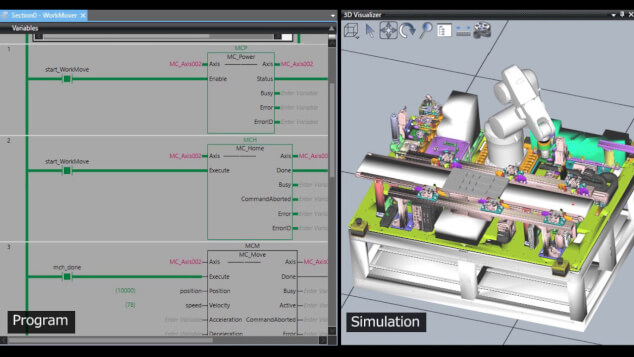
Sysmac Studio, OMRON’s simulation tool, empowers engineers with advanced tools for programming, simulation and monitoring of PLCs, motion controllers, vision systems and other automation devices. It offers three key benefits above and beyond other solutions for industrial automation: 
1. Safety logic
Safety is an aspect of factory design that is often overlooked by simulation providers. Too often, companies focus on the performance aspects of a system or process in their virtual testing, only to discover safety issues that require redesign at a much later stage. OMRON is unique in that its 3D simulation platform incorporates safety logic, allowing manufacturers to carry out comprehensive safety testing of functions such as emergency stops, safety light curtains and sensors, and to work out optimum strategies for the placement and programming of machine protection doors, for example.
2. Virtual debugging
The ability to debug an automation system design in a virtual environment is an application that few simulation providers can offer. OMRON has married high-fidelity rendering and simulation to engineer a 3D debugging application for identifying failures - users can virtually connect their sensors and debug a machine or line.
3. Function block library
OMRON has developed a library of PLC function blocks that can be used in the simulation environment as well as the real world. These software components are files that can be loaded into a control system to provide the PLC with all the functionality it needs to perform that particular application, thereby speeding up the design process. Drawing on OMRON’s extensive experience, they cover areas such as welding, winding, unwinding, press-fit tools, robotics, motion, inspection and more. The function blocks are also available for use in the virtual environment, enabling the creation of simulations that are much more detailed and much closer to reality.

Real benefits of virtual simulation

Simulation is a cornerstone of the digital factory. There are so many ways in which it can bring real benefits, from facilitating failure mode and effects analysis that can inform servicing strategies, to enabling parallelisation for performance optimisation and accelerating time to market by shortening planning and design cycles by up to 25% and more.

For the automotive industry, where product lifecycles are shrinking and innovation cycles are accelerating, simulation provides the agility needed to stay competitive. For example, a virtual twin of an electric vehicle battery production line will allow manufacturers to test workflows, optimise material handling and identify potential bottlenecks before investing in equipment.

In the cosmetics industry, where product design needs to consider seasonal trends, regional preferences and ingredient availability, simulation tools can test different formulations and manufacturing setups before physical trials are undertaken.

Through partnerships, OMRON brings new value propositions to manufacturers who want to explore advanced simulation approaches. Combining IT expertise and OMRON’s industrial automation knowhow, these collaborations allows for the open and fast exchange of real-time data between IT systems and OT operations, providing platforms for advancement of simulation solutions.

Contact us for more information

Contact Omron specialists

Do you have any questions or would you like personal advice? Feel free to contact one of our specialists.
  • Omron Europe

    Omron Europe