"Just add a camera." Often the four most expensive words in machine building.
Published on 08 June, 2026 in AI
For OEMs, a customer's request to "just add a camera" is common and, on the face of it, simple. To the customer the inspection itself may seem trivial: is the cap on? is the label the right one? is the part the correct way round?
The trap is often assuming that because the inspection is simple, the system needed to deliver it will be simple too.
A traditional vision setup is a stack of decisions, each its own small discipline. Selecting the camera and resolution. Choosing a lens and calculating the field of view. Specifying lighting and managing reflections, which is the single biggest determinant of whether the thing works at all. Sourcing trigger sensors, brackets and protection. Wiring to the controller, integrating the software, configuring the inspection tools.
Then the part nobody budgets for: tuning. Conventional systems need thresholds fine-tuned by iteration, and defect inspection has traditionally needed a skilled engineer to curate the training images by hand. Both can quietly consume days.
For an OEM the complexity compounds. Every separate component is another line on the BOM, another connector, more cabinet space, maybe even another supplier relationship. It creates a dependency: either you keep a vision specialist on staff, or you stay tied to an integrator every time a part changes.
Often it does not end at commissioning. Once the machine ships, the OEM usually owns the support burden too, including operator training and every "it stopped inspecting" call months later. That recurring cost is why so many genuinely simple inspections never get automated. The maths doesn't close.
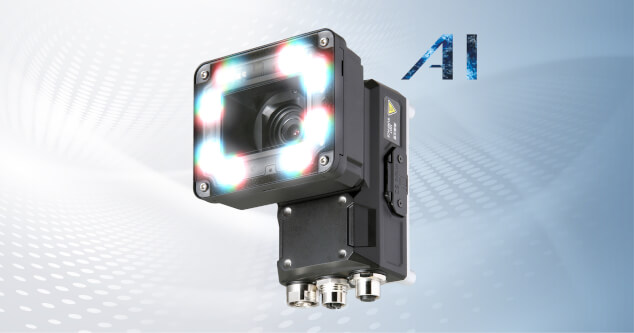
This is the calculus that integrated AI smart cameras change. OMRON's FHV7-AI puts camera, lighting, autofocus lens and image processing in one IP67 body, collapsing most of the selection and integration problem before you've written a line of config. Setup is guided: pick the inspection type, sort sample images into OK and NG, press learn. The self-learning AI then selects its own training images and sets the thresholds from the distribution of results, rather than leaving that to an engineer. Days become minutes, and the expertise tax largely disappears, for the builder and for the end user who must live with it.
The honest caveat: This will not replace a full high-end vision platform for harder applications, such as precision measurement, complex OCR or genuinely subtle defects and AI is only ever as good as the images it learns from.
But for the large middle ground of presence, type, orientation and simple defect, where the system integration overhead used to dwarf the inspection, that trade-off has shifted.
For machine builders, the value was never only in detecting the defect. It's in everything you no longer need to design, commission and support around it.
Vision is just one piece. See how it fits into the wider machine - motion, logic, safety and networking in one platform: SYSMAC
Contact us for more information